2 min read

Are Plastic Pipes Reliable?

Are Plastic Pipes Reliable?

Before 1970, the most commonly used piping for potable water was copper. However, the high cost of copper and the ease of installation of plastic piping caused an exponential increase in the use of plastic over the past 50 years.

In the late 1970s, polybutylene piping emerged. Due to the low cost of material, polybutylene piping systems were viewed as “the pipe of the future” and they readily became the preferred potable water piping.

However, in the 1990s, polybutylene piping got a bad reputation because of the high rate of failure. The high failure rate prompted a class action lawsuit and Shell (the company that developed the piping) stopped selling the product. The failure of the pipe was determined to be oxidative degradation by chlorinated water.

Today, the most commonly used plastic pipes include chlorinated polyvinylchloride (CPVC), crosslinked polyethylene (PEX), and polypropylene (PP). Each of these types of plastic pipes have their pros and cons as follows:

CPVC PIPE PROS
  • CPVC is easy to install, is non-flammable, resistant to heat, and resistant to oxidative embrittlement due to exposure to hot chlorinated water.
CONS
  • Unforgiving of sloppy installation practices. If the installer does not follow the installation rules (ASTM F3328 / ASTM D2855), the piping system may be unreliable and leak.
  • If excessive amounts of solvent cement are used to assemble the joints, the pipes may become brittle after a few years of service.
  • Not compatible with products that contain hydrocarbon chemicals. For example, overspray of cleaners, and moldicides, contact of the pipe with computer network cables, use of the wrong fire caulk, and exposure to a leak in an adjacent HVAC.
  • Not resistant to freeze failure
  PEX PIPE PROS
  • Easy to install
  • Resistant to most hydrocarbon chemicals
  • Flexible and resistant to freeze failure
CONS
  • Flammable
  • Brittle failure of the pipe can occur if not properly installed and/or operated at excessive pressure/temperature
  Polypropylene Pipe PROS
  • Resistant to most hydrocarbon chemicals
CONS
  • Unforgiving and prone to oxidative embrittlement if copper is present in the system (please see this pdf).
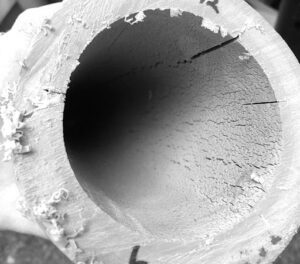
Polypropylene Pipe after exposure
Photograph showing the inside of a PP pipe after a few months of exposure to hot chlorinated municipal water.
  • PP is a plastic that is inherently oxidatively unstable due to the presence of tertiary H-atoms. Because of this, high levels of phenolic antioxidant and metal deactivating antioxidant stabilizers are added to the plastic. In recirculated hot water systems containing chlorinated water and traces of copper ions, the antioxidant stabilizers can get overwhelmed causing premature failure of the pipe.
  • Prone to failure if water flow rate, water pressure, and water temperature are too high.. 
  • Some PP pipe is reinforced by the addition of glass fibers to improve its resistance to thermal expansion/contraction and cyclical pressure stresses. Glass fiber reinforcement does make the pipe more forgiving, but failures are still likely in recirculated hot water systems unless operational conditions are carefully controlled within specifications.

CBS News 60 Minutes Interviews Dr. Duane Priddy for Gynecological Polypropylene Mesh Investigation

1 min read

CBS News 60 Minutes Interviews Dr. Duane Priddy for Gynecological Polypropylene Mesh Investigation

Leading plastics experts weigh in on the largest multi-district litigation since asbestos MIDLAND, MI – (May 17, 2018) — More...
Read More
Are Polypropylene Mesh Implants Safe?

1 min read

Are Polypropylene Mesh Implants Safe?

Recent problems and failures with PP mesh implants have led to thousands of hernia and surgical mesh lawsuits All products that contain hydrogen...

Read More
What Can Weaken Plastic?

1 min read

What Can Weaken Plastic?

The most common cause of plastic parts to weaken is exposure of the plastic to sunlight. Plastics consist of long polymer chain molecules...

Read More