 Download PDF
The Importance of CPVC Fire Sprinkler Piping Inspection
Don’t expect more than you inspect! When properly installed, fire sprinkler systems not only make a commercial or residential building safer for...
1 min read

Chlorinated polyvinylchloride (CPVC) is widely used for many piping systems including potable water, hydronic heating/cooling, corrosive liquid drains, and fire suppression systems. CPVC is popular because of its ease of installation and corrosion resistance. However, as with all plumbing products, occasionally pipes or fittings may fail. Our goal as forensic scientists is to determine the root cause of the failure of the CPVC piping and to provide the client with data that will help them select the most appropriate remediation option for their building. This paper presents four unique case studies, the forensic tools we used to evaluate the CPVC piping systems, and the logic behind the remediation option selected by the client.
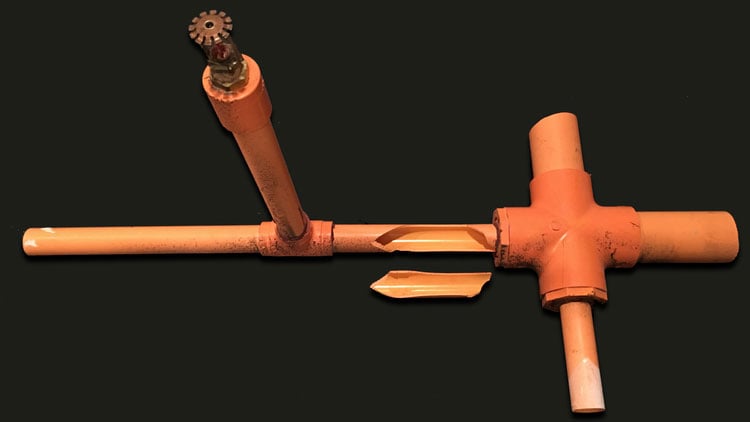
The first step in forensic failure analysis of CPVC pipes and fittings is to examine the fracture surfaces using optical microscopy and/or scanning electron microscopy (SEM) to determine the mode of failure. In the present study, there were a large number of failures in a new CPVC hydronic heating/cooling piping system (> 50,000-gallon capacity). Failure mode analysis was conducted on several of the failed fitting and pipe samples revealing that the failure mode was environmental stress cracking (ESC). Most of the failures were initiated in pockets of cement at the joints and propagated into the CPVC fitting and/or the pipe (Figure 1). The porous cement is sponge-like and absorbed hydrocarbons present in the water and concentrated the contaminants so that they migrated into the CPVC resin. Further analysis of the piping system revealed that there was extensive systemic contamination of the entire system with…
Don’t expect more than you inspect! When properly installed, fire sprinkler systems not only make a commercial or residential building safer for...
1 min read
Can your plastic pipe fittings handle the pressure? Polyvinyl chloride (PVC) piping is the highest volume of all plastic piping products. Rigid PVC...