
Failure Mode Knowledge Base
CPVC Environmental Stress Cracking (ESC)
Environmental stress cracking is the most common way CPVC pipe and fittings fail, and it is one of the most misdiagnosed. Here is how it happens, how we prove it, and how to prevent it.
Retained by both plaintiff and defense, for technical objectivity, not advocacy.
Failure Mode
What is CPVC ESC?
Environmental stress cracking is brittle cracking of a plastic that occurs when stress and contact with a certain chemical act together, at stress levels well below the material's normal strength. In CPVC it produces sudden, brittle cracks, often at fittings, joints, and other stress concentrations, even when the pipe looks intact. It is the single most common CPVC failure mechanism we investigate.
Field Signs
How CPVC ESC presents
Root Causes
Common incompatible chemicals and contributing factors
CPVC is incompatible with a range of common jobsite and building chemicals. Frequent culprits include common fire retardants found in spray polyurethane foam insulation; certain sealants, caulks, and firestop products; and some cutting oils, leak-detection sprays, antimicrobial sprays, and lubricants. Plasticizers migrating from adjacent flexible plastics can also attack CPVC. Contributing factors that raise the stress side of the equation include residual stress from the manufacturing process, bending or misalignment during installation, improperly assembled joints, poorly fused knitlines from molding or extrusion, and freeze or pressure-surge events.
Updated Science
Solvent cement can be the source, not just outside chemicals
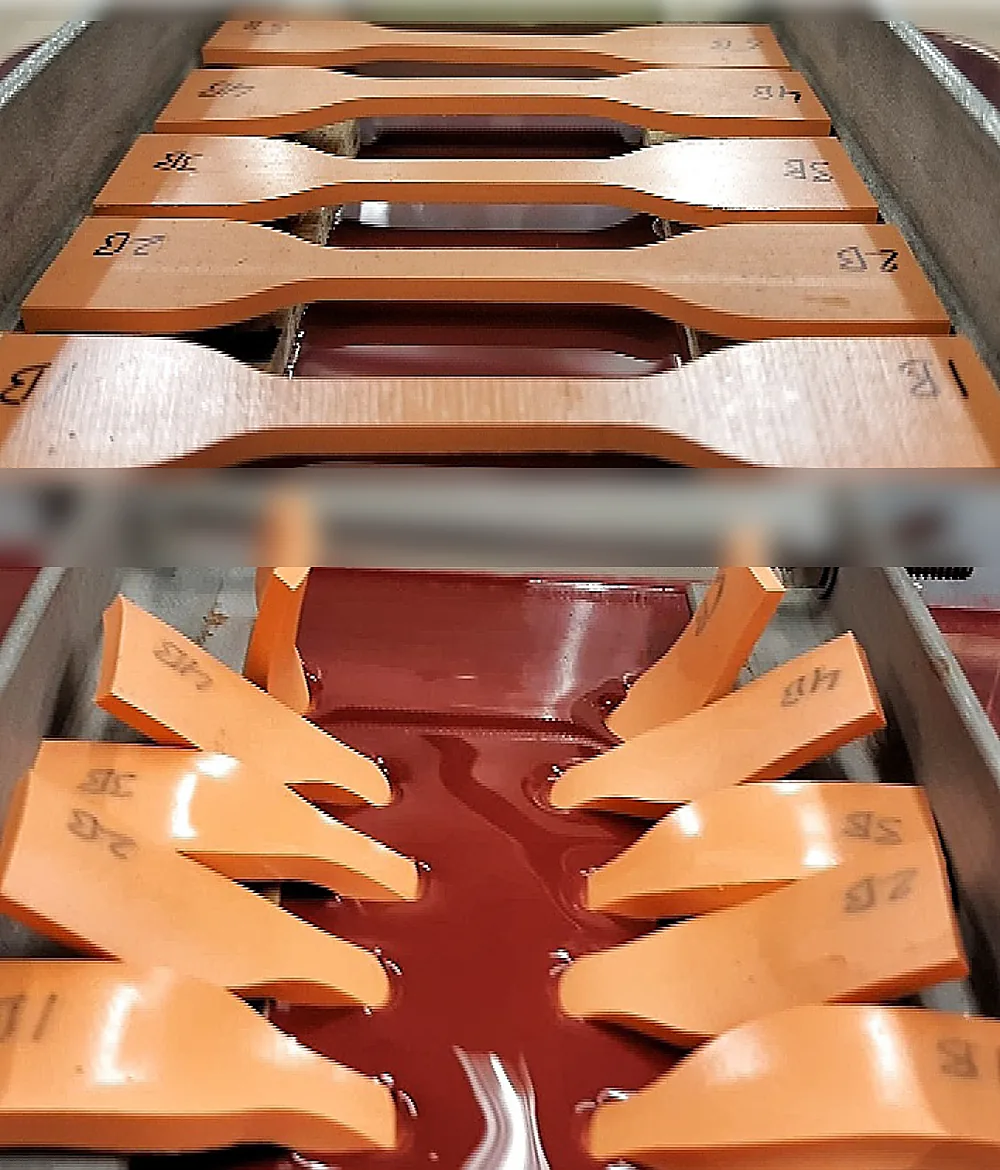
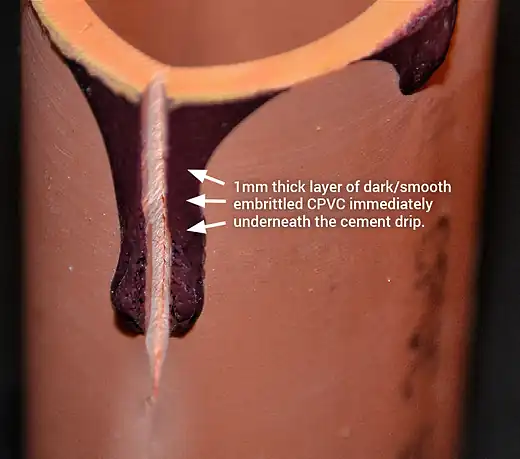
ESC on CPVC is not always caused by a chemical introduced from outside the pipe. The solvent cement used to make the joints can itself embrittle CPVC. Solvent cement contains aggressive solvents, some of which remain in cement residue for years, migrating into the pipe wall and reducing its ductility. Our published testing following ASTM D543 measured a significant loss of ductility in CPVC exposed to solvent cement, and the effect increases with the amount of cement (Koschitzki and Priddy, "CPVC Pipe Failure by Environmental Stress Cracking Without Exposure to Foreign Chemicals," SPE ANTEC Proceedings, 2024; full paper available on request). Independent peer-reviewed work reports the same effect: Chen, Ben Jar, Mertiny and Prybysh, Journal of Pressure Vessel Technology, 2020, volume 142, issue 2, article 021502, found that CPVC strength recovered to only about 63 percent of virgin pipe after 113 days of drying, and that ductility did not recover at all. Independent peer-reviewed research has reported a similar weakening effect from the acetone primer used in the two-step joining method (Mi et al., Polymers, 2023).
The recognized installation standard, ASTM F3328, is written to keep excess cement out of the joint and warns that excess cement can weaken the pipe and fitting.
Determining whether a given failure was caused by excess cement, an external chemical, an installation defect, or a manufacturing issue, and inspecting the inside of a system to find it, is part of our proprietary non-destructive testing protocol. If you have a failing or suspect CPVC system, talk to us.
Excess cement left inside a joint is a latent defect. A system can pass a pressure test with the cement still there, because a pressure test measures whether the joint holds, not what the joint is doing to the pipe wall. Establishing whether excess cement is present means inspecting the interior of the system, not testing its exterior performance.
Published Evidence
What excess solvent cement does to CPVC
From our ASTM D543 testing and forensic case work, published at SPE ANTEC 2024.
Our Method
How we diagnose CPVC ESC
We follow the scientific method with our network of independent, accredited affiliate laboratories:
This lets us distinguish ESC from other causes such as a manufacturing defect, an installation error, a freeze event, or simple overpressurization, and to state defensibly what actually caused the failure.
Prevention
How to prevent CPVC ESC
For Insurers and Attorneys
Why it matters for insurers and attorneys
Because CPVC ESC is often triggered by a third-party product such as a foam, sealant, or spray rather than the pipe itself, the root cause determines who is responsible. A defensible ESC analysis separates a product defect from an installation error or an incompatible-chemical attack, which is exactly what a subrogation recovery or a litigation defense turns on.
Across Engineering Plastics
CPVC is one of many plastics that stress-crack
CPVC is a good material choice for aqueous solutions of corrosive acids and for bleach: the vulnerability is specific, not general. CPVC is one of many thermoplastics that fail by environmental stress cracking. Amorphous plastics are the most prone, because they have no crystalline structure to slow an aggressive fluid from penetrating and plasticizing the polymer. CPVC, after chlorination, is fully amorphous, which is part of why it is so susceptible, whereas PVC itself carries only a small degree of crystallinity. The table below shows where stress cracking most often turns up across the engineering thermoplastics we analyze.
| Polymer | Class | Representative ESC agents | Where it shows up |
|---|---|---|---|
| CPVC | Amorphous | Most hydrocarbon chemicals; solvent-cement solvents; certain plasticizers and fire retardants; some sealants and oils | Fire-sprinkler and hot and cold plumbing pipe and fittings |
| Polycarbonate (PC) | Amorphous | Alkaline cleaners; ketones; greases and mold releases; gasoline | Eyewear and lenses, medical devices, housings, automotive lighting, glazing |
| ABS | Amorphous | Esters; ketones; chlorinated solvents; solvent-based adhesives and paints | Housings, automotive interior trim, appliances, pipe and fittings, toys |
| Acrylic (PMMA) | Amorphous | Alcohols; esters; ketones; aromatic hydrocarbons | Lenses, lighting, signage and displays, glazing, medical components |
| Polystyrene (GPPS) | Amorphous | Oils and fats; citrus terpenes; gasoline | Food packaging, disposable cups and cutlery, appliance and cosmetic parts |
| SAN | Amorphous | Alcohols and esters, similar to PS and ABS | Housewares, cups and tumblers, cosmetic packaging, instrument lenses |
| Modified PPO / PPE (e.g., Noryl) | Amorphous | Aliphatic and chlorinated hydrocarbons | Electrical enclosures, automotive, water-handling components |
| Polysulfone (PSU) | Amorphous | Ketones; esters; aromatic and chlorinated hydrocarbons | Repeatedly cleaned or autoclaved medical and food equipment, plumbing, membranes |
| Polyethersulfone (PES) | Amorphous | Polar aprotic solvents; ketones; esters | Medical devices, membranes, hot-water and steam contact |
| Polyetherimide (PEI, e.g., Ultem) | Amorphous | Chlorinated solvents | Electrical and electronic, aerospace, medical, high-temperature parts |
| Rigid PVC (uPVC) | Semi-crystalline | Ketones; esters; certain chlorinated solvents | Pipe and fittings, profiles, window frames, cladding |
| Polyethylene (HDPE, MDPE, LLDPE) | Semi-crystalline | Surfactants and detergents (the standard ESC test agents); soaps; silicone and mineral oils | Blow-molded bottles, pressure pipe (slow crack growth), fuel tanks, geomembranes, cable insulation |
| Polypropylene (PP) | Semi-crystalline | Strong oxidizers; hot chlorinated water | Pipe and fittings, automotive, appliances, hot-water and chemical service |
| Nylon (PA6, PA66) | Semi-crystalline | Metal-halide salt solutions such as road-salt de-icers; strong acids | Automotive under-hood parts, connectors, coolant and fluid components |
| Acetal (POM) | Semi-crystalline | Chlorinated potable water; acids; strong oxidizers | Plumbing fittings, valves, potable-water and appliance components |
| PET | Semi-crystalline | Alkaline solutions; acetone | Bottles and preforms, fibers, packaging, films |
| PBT | Semi-crystalline | Alkalis; hot aqueous service | Electrical connectors, automotive, appliance components |
Two mechanisms, told apart in the lab
Not every case on this list fails the same way. In true environmental stress cracking, a surfactant or solvent plasticizes the polymer and speeds up cracking under tensile stress with no change in molecular weight. In stress-accelerated chemical attack, the agent chemically degrades the polymer through hydrolysis, oxidation, or salt complexation, and stress accelerates it. Telling the two apart is central to naming the cause, the responsible party, and the fix.
We confirm the mechanism with standardized testing, including ASTM D1693 (the bent-strip Bell test), ASTM F1473 (PENT slow-crack-growth), and ISO 22088, alongside the ASTM D543 chemical-resistance and ASTM F3328 work referenced above. When a design has to survive aggressive chemical service, more crack-resistant resins are usually specified, such as PEEK, PPS, the fluoropolymers, and PPSU among the sulfones.
For any of these materials, we determine which mechanism drove the failure, which agent was involved, and where the stress came from: molded-in, assembly, or service. Where PVC or CPVC and solvent cement are involved, our conclusions rest on our own published testing (Koschitzki and Priddy, SPE ANTEC 2024).
Questions and Answers
CPVC stress cracking: common questions
What is environmental stress cracking in CPVC?
Environmental stress cracking is brittle cracking that occurs when tensile stress and contact with a certain chemical act together, at stress levels well below the material's normal strength. In CPVC it produces sudden brittle cracks, often at fittings, joints and other stress concentrations, even when the pipe looks intact. It is the single most common CPVC failure mechanism we investigate.
How do I recognize CPVC stress cracking in the field?
The fracture surface is brittle and glassy, with little or no ductile stretching, and cracks typically start at fittings, bends, solvent-cement joints, or where the pipe contacts another material. Failures usually appear suddenly after months or years in service rather than at installation.
Which chemicals attack CPVC?
Frequent culprits include common fire retardants found in spray polyurethane foam insulation, certain sealants, caulks and firestop products, and some cutting oils, leak-detection sprays, antimicrobial sprays and lubricants. Plasticizers migrating out of adjacent flexible plastics can also attack CPVC.
Can CPVC crack without any outside chemical touching it?
Yes. The solvent cement used to make the joints can itself embrittle CPVC, because it contains aggressive solvents that can remain in cement residue for years and migrate into the pipe wall. Our published testing following ASTM D543 measured a significant loss of ductility, and the effect increases with the amount of cement applied.
Does the pipe recover once the solvent has dried?
Not fully. Independent peer-reviewed work in the Journal of Pressure Vessel Technology found that CPVC strength recovered to only about 63 percent of virgin pipe after 113 days of drying, and that ductility did not recover at all.
Will a pressure test find this problem?
No. Excess cement left inside a joint is a latent defect, and a system can pass a pressure test with the cement still present, because a pressure test measures whether the joint holds, not what the joint is doing to the pipe wall. Establishing whether excess cement is present means inspecting the interior of the system rather than testing its exterior performance.
How is CPVC stress cracking proven in a laboratory?
We read the crack origin and growth using visual and optical microscopy, confirm the brittle signature with SEM fractography, and identify the chemical on the fracture surface using FTIR spectroscopy and GC-MS so that it can be matched to a suspected source. Standardized chemical-compatibility testing under ASTM D543 then proves or disproves that a specific chemical attacks CPVC.
How can CPVC stress cracking be prevented?
Verify chemical compatibility before any product contacts CPVC, follow the manufacturer's installation and solvent-cement instructions, keep incompatible materials away from CPVC lines, and test compatibility wherever it is uncertain rather than after it has been built into the project.
Does this mean CPVC is a poor material?
No. CPVC is a good material choice for aqueous solutions of corrosive acids and for bleach, so the vulnerability is specific rather than general. What makes CPVC susceptible is that it is fully amorphous after chlorination, with no crystalline structure to slow an aggressive fluid from penetrating and plasticizing the polymer.
Do other plastics fail the same way?
Yes. Environmental stress cracking affects many thermoplastics, with amorphous grades the most prone. It is also important to separate true environmental stress cracking, where an agent plasticizes the polymer with no change in molecular weight, from stress-accelerated chemical attack, where the agent chemically degrades the polymer and stress accelerates it.
Why does the root cause matter for an insurance or legal claim?
Because CPVC stress cracking is often triggered by a third-party product such as a foam, sealant or spray rather than the pipe itself, the root cause determines who is responsible. A defensible analysis separates a product defect from an installation error or an incompatible-chemical attack, which is what a subrogation recovery or a litigation defense turns on.
Related Services
Accreditations & Affiliations
Independent accredited labs across North America, Europe, Asia-Pacific, Australia, and the Middle East

ESC investigation
Investigating a CPVC stress-cracking failure?
Environmental stress cracking in CPVC is often mistaken for a manufacturing defect. We identify the true cause: chemical incompatibility, installation, or material. Confidential review.
Fast Initial Review
No-cost initial assessment for attorneys, insurers, manufacturers, and property owners.
Daubert-Aligned Methodology
A2LA-accredited testing built to survive a Daubert challenge.
Prefer to Call?
+1 (989) 281-4465