Water-Loss & Subrogation Support
Why Did the Pipe Fail? Forensic Answers for Water-Loss Claims and Subrogation
When a plastic plumbing or fire-sprinkler pipe lets go, the water damage is only the first cost. The next question decides the case: why did it fail, and who is responsible? Plastic Expert Group is a forensic materials team built for exactly that question. We determine the root cause of plastic pipe and component water-loss failures across CPVC, PVC, PEX, polybutylene, PE, PP-R, HDPE, ABS, PP, EPDM, and PVDF, and document it to the scientific certainty that subrogation recovery and litigation require, helping property and casualty carriers, third-party administrators, adjusters, and subrogation counsel separate a defective pipe from a defective installation from normal wear, with independent, A2LA-accredited laboratory testing built to withstand Daubert scrutiny.
In the Lab
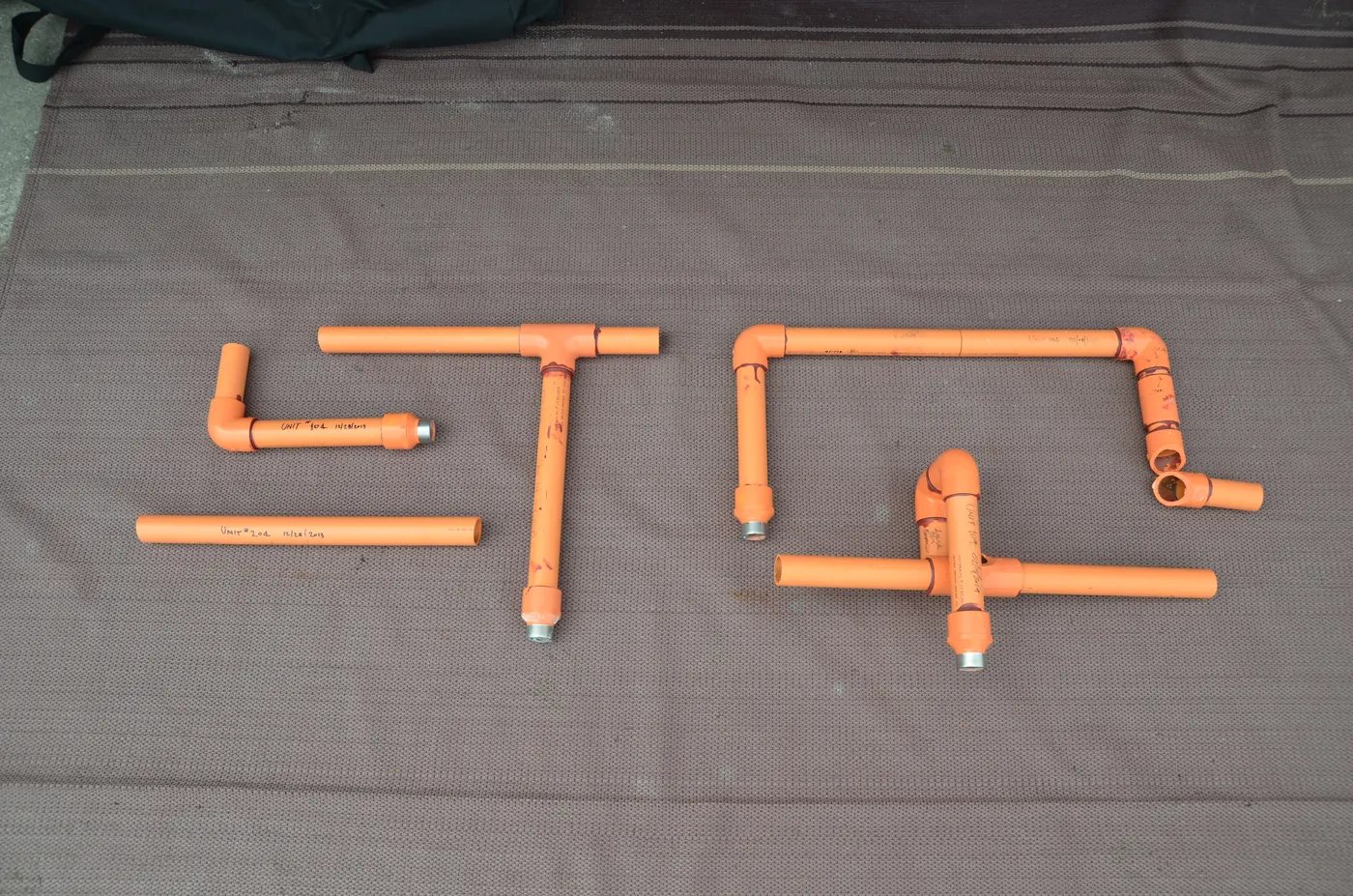
Pictured: Pipe failure root-cause analysis
580+
Litigation-Related Projects & Claims
50+
Buildings Investigated
A2LA
Accredited Affiliate Labs (Independent Testing)
ASTM F17
Plastic-Piping Standards Contributors
Case Snapshot
Recognize Your Claim in 30 Seconds
PEX slab / recirculating-line water loss
- Claim Type
- First-party water-damage claim with subrogation potential
- Setting
- Single- and multi-family residential; warm, high-chlorine regions (CA, FL, TX, AZ, NV, HI)
- Pipe Material
- PEXa / PEXb / PEXc domestic water, especially hot recirculating lines
- Failure Mode
- Chlorine oxidative degradation, expansion-fitting stress cracking, or premature oxidative failure from antioxidant depletion
- Our Role
- Independent cause-and-origin analyst, subrogation-support expert, expert witness
- Carrier Gets
- Root-cause determination, defect-versus-wear opinion, responsible-party attribution, and the scope of exposure for recovery
CPVC fire-sprinkler discharge / multi-unit water loss
- Claim Type
- Large-loss or commercial property; construction-defect and subrogation
- Setting
- Multi-family residential, high-rise, hospitality (life-safety sprinkler systems)
- Pipe Material
- CPVC fire-sprinkler piping
- Failure Mode
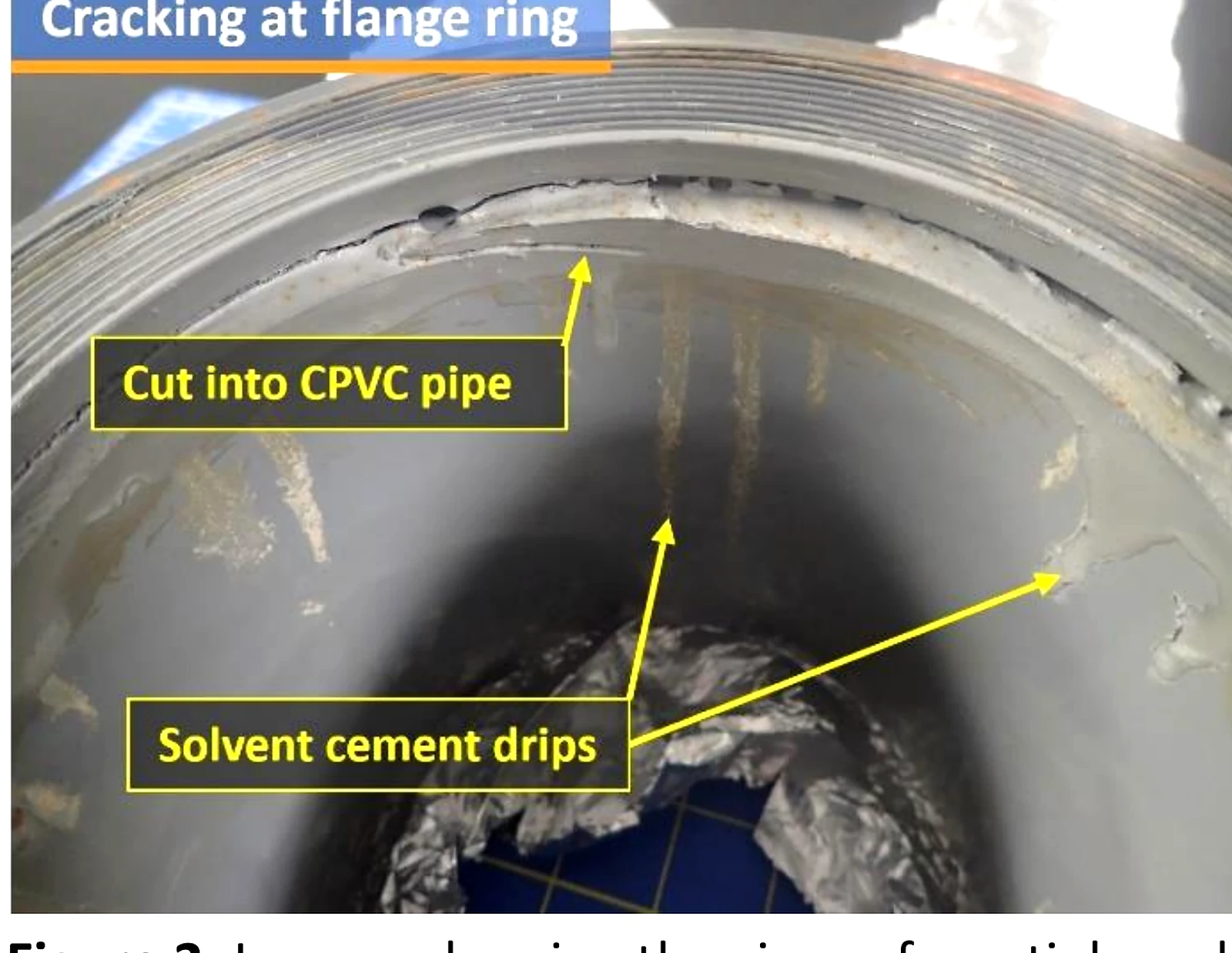
- Environmental stress cracking from incompatible firestop or acoustical caulk, spray foam, or improper joint installation
- Our Role
- Cause-and-origin expert, chemical-incompatibility analyst, remediation-scope consultant
- Carrier Gets
- Chemical-to-source attribution, a systemic-versus-isolated finding, and remediation scope plus prospective exposure
The Challenge
Three Questions Decide Whether a Water Loss Is Recoverable
Escaped-water damage is one of the highest-frequency and highest-severity lines in property insurance, and plastic plumbing sits at the center of it. For the carrier, the loss itself is usually straightforward to adjust. The hard part comes after the dry-out: deciding whether the failure is recoverable. Three questions decide the case, and they are exactly the questions a defective pipe is designed to blur:
Causation. Did the pipe fail because it was defective, because it was installed wrong, or because it simply reached the end of a normal service life? Each answer points at a different party, or at no party at all.
Attribution. If it was a defect, whose? The manufacturer, the installer, the general contractor, or the supplier of a product that damaged the pipe? Plastic-pipe failures frequently involve more than one responsible party.
Scope and exposure. Is this one bad joint, or a building-wide latent defect that will keep generating claims? The answer changes both the reserve and the recovery.
Most water-loss claims are dried out and closed without anyone determining the failure mode, so the failed pipe is the easiest evidence to lose and the easiest theory to rebut. By the time a subrogation referral is opened, the sample is often repaired over, discarded, or shipped to the manufacturer. A spoiled sample is the single hardest problem to overcome, and it is avoidable.
How We Determine Cause and Liability
A Forensic Process Aligned to the Coverage Decision
Our forensic process mirrors the decision a carrier actually has to make. Every test is chosen to answer a coverage or recovery question, not only a scientific one: reproducible, non-destructive where possible, and court-ready.
Stage 1
Identify the material and preserve the evidence
We confirm exactly what failed (CPVC, PEXa/b/c, polybutylene, the fitting, the solvent weld) and stabilize the chain of custody before anything is altered. Material and manufacturer identification is almost always possible, because the product line is printed down the pipe and, when a removed piece is unmarked, we identify it from adjacent pipe in the building.
Stage 2
Determine root cause and assign responsibility
- 1
On-site non-destructive inspection
Proprietary non-destructive inspection techniques inspect the system from the inside and photo-document every joint against applicable ASTM standards and the manufacturer's installation instructions, capturing installation and code violations without destroying evidence.
- 2
Joint assembly verification
Our proprietary non-destructive inspection shows discontinuities and whether a pipe was fully inserted and rotated in the fitting socket, distinguishing an installation defect from a pipe defect.
- 3
FTIR contaminant identification
Every chemical has a unique infrared fingerprint. We match a contaminant on a failed fracture surface against a library of tens of thousands of compounds, then analyze the products that contacted the pipe to tie the chemical to its source.
- 4
SEM fracture analysis
Scanning electron microscopy shows where a crack began: the inside surface, the outside surface, or within the pipe wall. Each origin indicates a different failure mode, which separates competing theories of the loss.
- 5
DSC oxidative induction time (ASTM D3895)
Measures how much antioxidant stabilizer remains in a PEX wall. Our experts interpret the result against the pipe's rated service life to determine whether it was adequately protected.
- 6
Chemical-compatibility testing (ASTM D543)
A controlled, stressed-specimen test proving whether a specific product such as a caulk, foam, or cement is chemically incompatible with the pipe, turning a theory into evidence.
Stage 3
Quantify the scope and support recovery
A random statistical sample establishes, at 95 percent confidence, whether the defect or contamination is systemic or localized. That single finding drives both the carrier's exposure (how much at-risk pipe remains) and the recovery posture (a one-off versus a building-wide latent defect). We deliver the result as a report that counsel can file.
Key Findings
What Our Reports Establish
- 1
Root cause to a high degree of scientific certainty
When the testing confirms an incompatible chemical on the fracture surface, or antioxidant stabilizer depletion in the pipe wall, we state the mechanism that caused the failure and what it indicates for the reliability of the rest of the system.
- 2
Defect versus normal wear
Depleted antioxidants plus inside-wall crack initiation after only a few years of service is premature failure of an under-stabilized, defective pipe, not normal aging. This is the line between a recoverable subrogation case and a closed one.
- 3
Responsible-party attribution
We tie the failure to the manufacturer, the installer, or the supplier of an incompatible product, and where several causes overlap we prove the source of each and help counsel apportion liability.
- 4
Systemic latent defect and prospective exposure
Where contamination or a manufacturing defect is systemic, failure across the system is eventually certain but unpredictable in timing. For a water-loss exposure, that supports valuing the whole at-risk population of pipe, not only what has already leaked.
- 5
Foreseeability
Where a manufacturer's warnings were inadequate or the failure mechanism has been known in the industry for years, we document it.
The Deliverables We Provide
Each written to be defensible under Daubert:
- Expert Reports
- Product Liability Reports
- Fitness-for-Purpose Reports
- Root Cause Analysis Reports
- Insurance Claims Review and Subrogation Support Reports
Outcome & Impact
From a Water-Loss Case to a Defensible Recovery Position
The clearest illustration comes from our pipe-failure casework. In a large condominium with CPVC fire-sprinkler failures, our team traced the cause to acoustical and firestop caulks at wall penetrations that are highly incompatible with CPVC. A random statistical analysis established, at 95 percent confidence, that 71 to 90 percent of the wall-penetration caulks in the building were incompatible. We then measured how far the incompatible chemical migrates along the pipe, 3.5 inches, and for a margin of safety recommended replacing all pipe within 7 inches of caulk at every wall penetration. Once the report was disclosed, it defined the scope and cost basis of the recommended remediation. For a carrier, that same workflow converts a water-loss case into two things it can act on: a defensible recovery position against the responsible party, and a defensible loss estimate for the at-risk pipe that has not yet failed. Whether the question is one unit or an entire building, the method is the same: determine the mechanism, attribute it to a party, and quantify the scope to the certainty a recovery requires.
Why This Matters for Your Claims Operation
Three Implications for Claims and Subrogation
The 2000s construction boom put enormous volumes of CPVC, PEX, and earlier, polybutylene into buildings, and that pipe is now well into its service life and is failing in the field, as water losses. Three implications for a claims and subrogation operation:
Recovery is being left on the table. Most water losses are dried out and closed before anyone determines the failure mode. Across a book of business, undiagnosed pipe failures are unrecovered subrogation dollars.
Pattern losses are recovery opportunities. When the same pipe or fitting fails repeatedly across many insureds in the same region or vintage, that is the signature of a manufacturing or material defect, and the basis for coordinated recovery. The statistical and material evidence that establishes a systemic defect on one claim supports the pattern across many.
The evidence has a short clock. A plastic pipe-specific forensic expert should be engaged before the failed sample is removed. The most common, and most damaging, error is letting the sample be repaired over, discarded, or sent to the manufacturer before an independent cause-and-origin analysis is completed.
Water losses also rarely stay in one technical lane. When a failure implicates the structure, the building envelope, or code compliance as well as the pipe, our materials findings are built to sit alongside the other disciplines on the case rather than compete with them.
Quick-Reference Checklists
Two Lists for the Claims Desk
For Adjusters and TPAs
Preserve a Water-Loss Claim for Subrogation (First 72 Hours)
- Video the water actively escaping from the failed pipe; photograph the surrounding damage.
- Photograph the removal and any repair of the piping in place.
- Secure the failed pipe sample and start a chain-of-custody form that travels with it.
- Wrap the sample in pure aluminum foil, then bag and tag it with date and location.
- Store it in a controlled, secure environment. Do not send the only failed sample to the manufacturer.
- Engage a plastics-pipe forensic expert before the sample is removed wherever possible. Do not default to a generalist; Daubert exclusion is a real risk.
- Preserve the basics for recovery: pipe manufacturer and lot if available, the age of the system, whether this is a first or repeat failure, and document everything that was touching the pipe.
Subrogation Triggers
When to Open a Subrogation Referral
- The pipe is plastic (CPVC, PEX, or polybutylene) and the system is well short of its rated service life.
- The same pipe, fitting, or failure mode is showing up across multiple insureds, buildings, or a single development.
- There is any sign of an incompatible product (spray foam, firestop or acoustical caulk) in contact with a CPVC system.
- The loss is large, or one of many in the same building.
Authority
What Makes Plastic Pipes Fail and Cause Water Loss
- 1
Manufacturing
A defect in the pipe or fitting itself, such as a poorly fused extrusion knit-line or, in PEX, an under-stabilized pipe that oxidizes prematurely in hot chlorinated service. Points to the manufacturer.
- 2
Workmanship (installation)
A pipe not fully inserted or rotated in the fitting, an improperly made solvent-weld joint, or an unsupported sharp bend. Points to the installer or contractor.
- 3
Environment (chemical incompatibility)
An external product that attacks the pipe. CPVC is a good material choice for aqueous solutions of corrosive acids and for bleach; the vulnerability is specific, not general. CPVC is incompatible with the great majority of hydrocarbon chemicals; ester plasticizers and the common fire retardants in spray foam and many caulks are among the frequent culprits. Under water pressure, stressed CPVC absorbs the migrating chemical and environmental stress cracking follows. Points to the supplier or installer of the incompatible product.
- 4
End-user and operating conditions
Service outside the design envelope, for example sustained high temperature or elevated chlorine and chlorine-dioxide levels. This may point to no recoverable party, which is exactly why it must be ruled out with evidence rather than assumed.
By material, the water-loss profile differs. CPVC fails predominantly by chemical-incompatibility stress cracking and tends to surface 1 to 20 years after installation. PEX fails by chlorine oxidative degradation, expansion-fitting cracking, and antioxidant depletion, concentrated in warm, high-chlorine regions. Polybutylene is the legacy material behind a generation of water-loss claims and remains in millions of older homes. Naming the material is the first step in naming the defendant.
FAQ
Common Questions From Carriers, TPAs, and Subrogation Counsel
Related Use Cases & Services
Explore our pipe-failure pages
Pipe Failure Analysis
Our broader pipe-failure practice: CPVC, PEX, and polybutylene investigations across litigation, subrogation, and HOA matters.
Read moreCPVC Fire Sprinkler Pipe Failure
Environmental stress cracking from incompatible caulks and foams, four failure tracks, and large-loss subrogation casework.
Read moreCPVC Environmental Stress Cracking
The failure mode in depth: how incompatible caulks, foams, and sealants embrittle CPVC under stress, and how we tell ESC from a manufacturing defect or freeze.
Read moreCPVC Chemical Resistance
Why CPVC resists aqueous acids and bleach but is not resistant to most hydrocarbon chemicals, across fire sprinkler, potable water, drain, and industrial service.
Read morePEX Pipe Failures
Chlorine oxidation, expansion-fitting cracking, and antioxidant depletion behind PEX water-loss claims in warm regions.
Read moreData Center Piping
CPVC and PVC drain, chilled-water, and condensate line failures behind mission-critical data-center water-loss events.
Read moreExpert Witness & Litigation Support
Daubert-aligned expert testimony grounded in independent A2LA-accredited testing.
Read moreRelated Services
Accreditations & Affiliations
Independent accredited labs across North America, Europe, Asia-Pacific, Australia, and the Middle East

For Carriers and Subrogation Counsel
Have a Water-Loss Claim That Might Be Recoverable?
Our forensic team and independent, A2LA-accredited affiliate labs determine why CPVC, PEX, and polybutylene pipes fail and document it to the certainty subrogation and litigation require. We have supported 580+ litigation-related projects and claims and investigated failures in 50+ buildings nationwide, and our experts are active in the claims and litigation management community. Get a no-cost initial claim review.
Have This Ready
- Pipe material and manufacturer if known
- Age of the system
- First failure or one of many
- When the first failure occurred
- Who is holding the failed sample(s)
- Photos available
- Was anything touching the pipe
- Municipal or well water
- For municipal water, any treatment changes or boil-water notices
For Adjusters and TPAs
Not Sure if a Water Loss Is Worth a Subrogation Referral?
Send us the basics and we will tell you whether the failure mode is likely recoverable before you commit to an investigation.
Tell Us About Your Water-Loss Claim
Share the building, what failed, and what you have. We will respond within one business day with next steps and whether a non-destructive inspection or sample review makes sense first.
Fast Initial Review
No-cost initial assessment for attorneys, insurers, manufacturers, and property owners.
Independent A2LA-Accredited Testing
Court-ready methodology built to survive a Daubert challenge.
Prefer to Call?
+1 (989) 281-4465