
Plastic Materials Testing & Laboratory Consulting
Plastic Materials Testing and Laboratory Consulting
Companies and counsel use our accredited affiliate-lab network three ways:
- To find the root cause of a failure for litigation.
- To select and verify the right material before a product ships.
- To predict service life and support a regulatory submission.
In every case the testing is performed by independent A2LA-accredited laboratories, so the data is unbiased and defensible, and the results are interpreted by polymer scientists who explain what they mean in plain language. Our team has supported 580+ litigation-related projects and serves aerospace, medical, energy, transportation, and consumer-product clients with the full analytical menu: FTIR, SEM with EDS, GC-MS, DSC, TGA, GPC, mechanical testing, and accelerated aging.
In the Lab
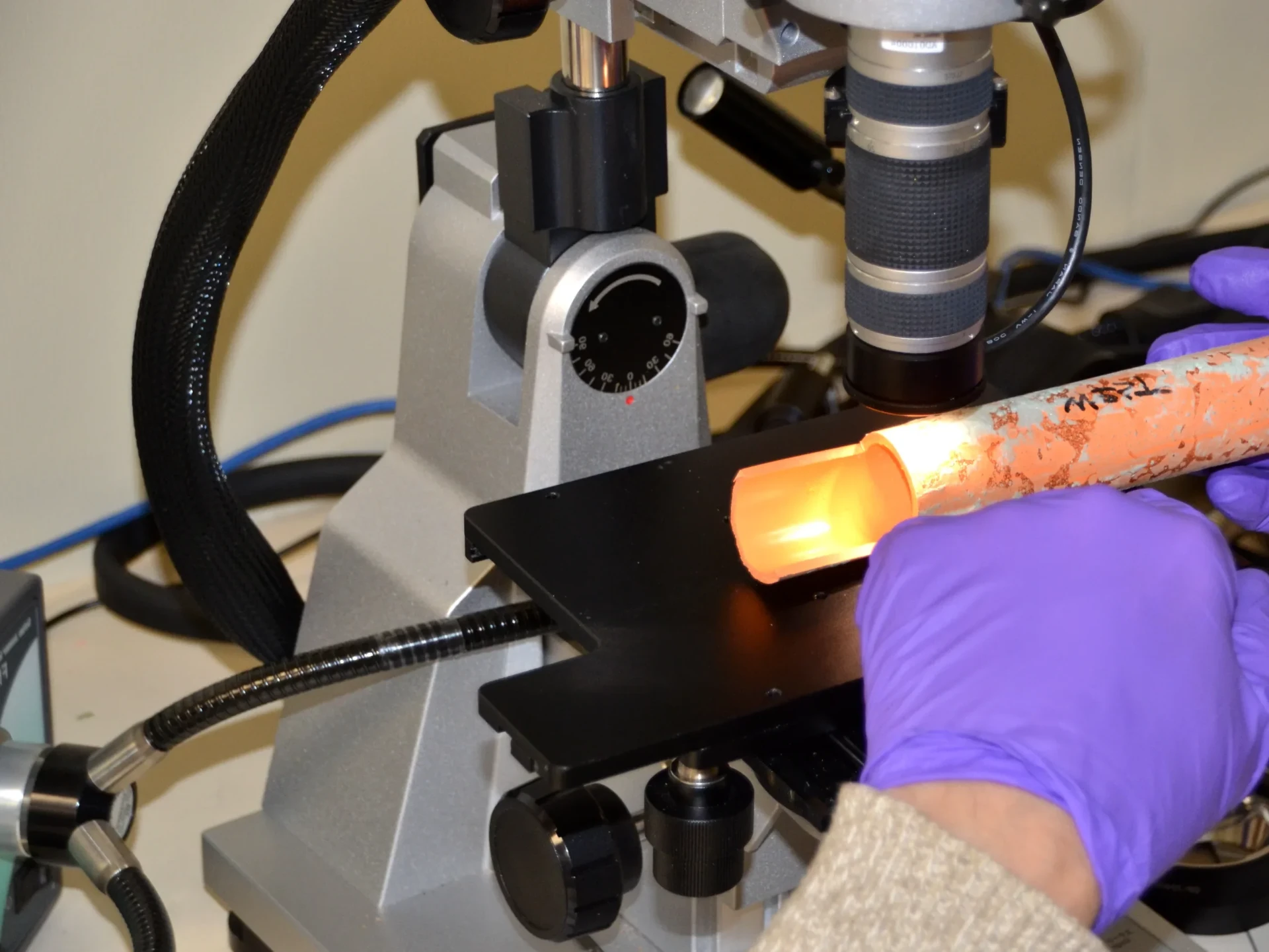
Pictured: Accredited materials testing
580+
Litigation-Related Projects
A2LA
Accredited Affiliate Labs
Full Menu
Polymer Analytical Suite
3-Way
Forensic · Design · Regulatory
Case Snapshots
Three Ways Clients Use Our Affiliate-Lab Network
The fact patterns we see most often on materials testing engagements.
Snapshot A: Forensic Testing for Litigation
- Setting
- Consumer products, construction materials, medical devices, aerospace components
- Material
- Any failed polymer part or pipe
- Testing
- FTIR, SEM/EDS, GC-MS, DSC, mechanical testing, full chain of custody
- Legal Issue
- Material-identity dispute, contamination causation, manufacturing defect, material-substitution fraud
- Our Role
- Plaintiff, defense, neutral, or rebuttal testing
- Outcome
- Root cause confirmed and settlement reached, or an opposing expert's results rebutted
Snapshot B: Material Selection & Design Consulting
- Setting
- Medical-device OEMs, automotive tier-1 suppliers, consumer-product companies, aerospace subcontractors
- Challenge
- Choosing the right resin for a chemical or thermal application, verifying incoming material, qualifying a supplier
- Testing
- FTIR identity, DSC grade verification, mechanical testing, ASTM D543 chemical resistance, accelerated aging, FEA and mold-flow support
- Our Role
- Independent materials consultant
- Outcome
- The correct material identified and a costly redesign or recall avoided
Snapshot C: Service Life & Regulatory Compliance
- Setting
- Medical (FDA / ISO 10993), aerospace (FAA), energy infrastructure, transportation
- Product
- Implantable polymers, structural composites, pipeline coatings, under-hood components
- Protocol
- Q10 accelerated oven aging, xenon-arc weathering, thermal cycling, chemical immersion, TGA filler verification
- Our Role
- Independent testing and regulatory-submission consultant
- Outcome
- A submission supported, a service-life claim validated, or a premature field failure predicted and corrected before launch
The Challenge
Credibility, the Datasheet Gap, and Accelerated-Test Validity
Three problems make materials questions hard:
- Credibility. Opposing counsel attacks chain of custody (COC) and lab bias, which is why we keep meticulous COC records and run testing only through independent A2LA-accredited laboratories rather than an in-house lab with a stake in the outcome.
- The gap between the datasheet and the real world. For example, the ASTM test used to predict service life of PEX pipe (ASTM F2023) is run under controlled lab conditions using unrealistic conditions, highly purified water and sodium hypochlorite as the chlorine source, while real systems see chlorine dioxide, chloramines, and trace iron and copper that oxidize far more aggressively, so a pipe rated for 50 years can fail after only a few years in service.
- The validity of accelerated testing. The Q10 protocol is only reliable when the acceleration temperatures stay below the polymer's glass transition temperature (Tg), because above Tg the degradation mechanism changes and the prediction becomes meaningless.
A recurring trap: a part can meet every dimensional specification and still fail, because parts fail at internal flaws such as voids, contamination, and fiber bundles that a dimension check never catches.
Approach & Methodology
How We Build a Materials Testing Program
We use a scientific methodology matched to your application's requirements; the specific techniques are PEG proprietary methods. At a high level, a materials-testing program moves through three phases.
- 1
Scope the program to your matter
We match the tests to the questions your matter must answer, using a scientific methodology tuned to your application rather than a fixed checklist. For clients who engage us at the design stage, a DFMA and FMEA review helps define the right program.
- 2
Run it at an accredited lab
All testing runs through independent A2LA-accredited or ISO-accredited laboratories to eliminate bias, and results are shared with all parties.
- 3
Interpret and prove
Using our proprietary methods, we determine whether the failure traces to grade, processing, contamination, or service life, and we explain what the result proves and who it points to.
Standardized Test Methods
Browse our full catalog of 257+ standardized test methods across ASTM, ISO, and AS/NZS standards.
Key Findings
What Our Reports Establish
Root-cause sequence
CT and SEM/EDS establish the failure mode; if it is environmental stress cracking, FTIR and GC-MS identify the chemical and then its source.
Regrind and degradation
GPC showing an excess of short polymer chains proves excessive regrind or in-service degradation, both of which weaken the part.
Material substitution
A change of resin grade or supplier is proven by GPC (chain-length distribution) plus LC-MS (additive package), beyond what FTIR and DSC alone can confirm.
Spec non-conformance
TGA, mechanical testing, and OIT show when filler content, strength, or antioxidant levels fall below specification, and internal flaws such as voids, contamination, or fiber bundles explain parts that pass a dimension check yet fail in service.
Service life
We report a minimum expected service life for a defined set of use conditions with a stated confidence level, not a single unqualified number.
Industry Verticals
Standards, Failure Modes, and Consequences by Sector
Each sector has its own standards, failure modes, and consequences. We tailor the analytical program to the regulatory environment and the materials at risk.
Aerospace
Structural composites, seals, and wire insulation must survive extreme cycling and meet FAA accreditation and AC 23-20 guidance; the most common composite failure we see is parallel fiber alignment at weld lines from a poorly located mold gate, which a mold fill-and-pack analysis would have prevented.
Medical Devices
Implantable and body-contact polymers require ISO 10993 biocompatibility and extractables-and-leachables testing and an ISO 14971 risk assessment, with chemical characterization now central since the 2018 to 2023 updates; the lesson our team has testified to is that an unstable polymer should never be chosen for permanent implantation when an inert material is available.
Energy Infrastructure
Coatings, cable insulation, and tank liners need carefully designed Arrhenius testing, often at five temperatures, with ASTM D543 to capture petroleum-chemical exposure.
Transportation & Automotive
Under-hood parts face heat and fluids, and lightweighting has consequences. In one matter a plastic composite automotive part failed in brittle fashion because it could not withstand high-speed vibration, with fatal consequences.
Consumer Products
Across toys, housewares, and sporting goods we start with a CT scan, then SEM/EDS for the failure mode, then FTIR or GC-MS when the mode is stress cracking (ESC).
Outcome & Impact
Representative Outcomes
Glass-fiber content non-conformance
In a product-failure matter the part was specified to contain 30 percent glass fiber for strength; our TGA analysis showed it actually contained only 15 percent, which explained the failure and established the material non-conformance.
Recycled-resin contamination
DSC proved a part molded from material that was supposed to be a single polyolefin actually contained both polypropylene and high-density polyethylene, while GPC showed a population of short chains that revealed degradation, and the case settled when the report was disclosed.
Substitution caught before launch
In design and supplier work, FTIR and DSC acceptance testing, backed by GPC and LC-MS, has caught material substitutions before the parts reached the market, avoiding field failures and recalls.
Why This Matters
Three Forces Are Increasing Materials Risk Right Now
Three forces are raising materials risk right now:
- Supply-chain disruption and reshoring have pushed manufacturers to qualify new suppliers and switch resin grades, and a substitution shows up as a different additive package, a different chain-length distribution, or the presence of regrind, all detectable with LC-MS and GPC.
- Sustainability mandates are driving bio-based and recycled-content reformulations that are frequently launched without rigorous equivalency testing, and recycled or thinner-walled parts fail at higher rates.
- Regulatory scrutiny is tightening, with the FDA and notified bodies demanding far more chemical characterization and risk assessment than five years ago.
Against any of these, a forensic testing program is a modest investment relative to the matter, recall, or regulatory delay it addresses, which typically runs into six figures or more.
Quick-Reference Checklists
Three Lists, Side by Side
Attorney / Litigation Support
Evidence & Lab Vetting
- Photograph the device and the failed part in place; for a pipe, video the leak and the removal.
- Remove the entire failed section including the fittings on both ends.
- Wrap the sample in pure aluminum foil and package it so it isn't damaged in transit.
- Create and maintain a chain-of-custody document recording every transfer.
- Preserve an un-failed exemplar.
- Before authorizing testing, ask the lab what quality accreditation it holds, how often it calibrates, and whether it runs SEM/EDS, FTIR, GC-MS, DSC, TGA, and ASTM D638 in house.
Engineer / Product Development
Design & Acceptance Testing
- Before committing a resin, supplier, and mold, run finite element analysis, mold fill-and-pack analysis, and a Failure Mode and Effects Analysis.
- On each incoming lot, verify identity with FTIR and DSC.
- Confirm antioxidant level with OIT (ASTM D3895).
- Check molded-in stress with the heat-reversion dimensional test; a change over 5 percent signals high residual stress and likely failure.
Regulatory / Compliance
FDA Submission Essentials
- For an FDA submission, secure from an accredited lab the extractables-and-leachables testing (ISO 10993, 21 CFR 211.94).
- Mechanical and barrier-property data.
- Sterilization and shelf-life validation (ISO 11607).
- A toxicological risk assessment (ISO 14971).
FAQ
Common Questions About Materials Testing
Related Use Cases & Services
Related Investigations and Services
Plastic Failure Analysis
All polymer failure modes across products, parts, pipes, and coatings.
Read moreForensic Testing
Court-admissible forensic testing services and the full A2LA-accredited analytical menu for attorneys and insurers.
Read morePlastic Molding Defects
The Four-Parameter framework for resolving design-versus-molding-defect disputes with CT, SEM, FEA, and mold-flow analysis.
Read moreAccreditations & Affiliations
Independent accredited labs across North America, Europe, Asia-Pacific, Australia, and the Middle East

Litigation Attorney
Need Independent Materials Testing for a Product-Liability or Manufacturing Dispute?
Our network of independent, A2LA-accredited affiliate laboratories delivers FTIR, SEM, GC-MS, DSC, TGA, GPC, and mechanical testing with full chain of custody and court-ready expert reports, across 580+ litigation-related projects for plaintiff and defense counsel.
Engineer / Product Company
Selecting a Material, Qualifying a Supplier, or Verifying a Process?
Our polymer materials expert consultants catch the problem before it becomes a field failure.
Regulatory / Compliance
Preparing a Polymer Submission for FDA, FAA, or UL Review?
Our accredited testing and documentation support submissions across medical, aerospace, and energy.
Tell Us About Your Materials Testing Needs
Share the application, what you need confirmed, and what you have. We will respond within one business day with next steps and the analytical menu that fits the question.
Fast Initial Review
No-cost initial assessment for attorneys, insurers, manufacturers, and property owners.
Independent A2LA-Accredited Testing
Court-ready data built to survive a Daubert challenge.
Prefer to Call?
+1 (989) 281-4465