Mission-Critical Piping
Data Center Cooling & Drain Piping Failure Analysis
Modern data centers run on water. Chilled-water loops, condenser lines, make-up water, and condensate drains keep racks within a few degrees of their limits, and a growing share of that piping is plastic. When a single solvent-cemented joint or molded fitting lets go, the cost is measured, not in pipe, but in flooded white space, unplanned downtime, and emergency remediation. Our forensic team has investigated these failures across multiple data center campuses. We also work alongside operators, developers, and their design teams before a system is built, to engineer that risk out early.
Data Center Cooling
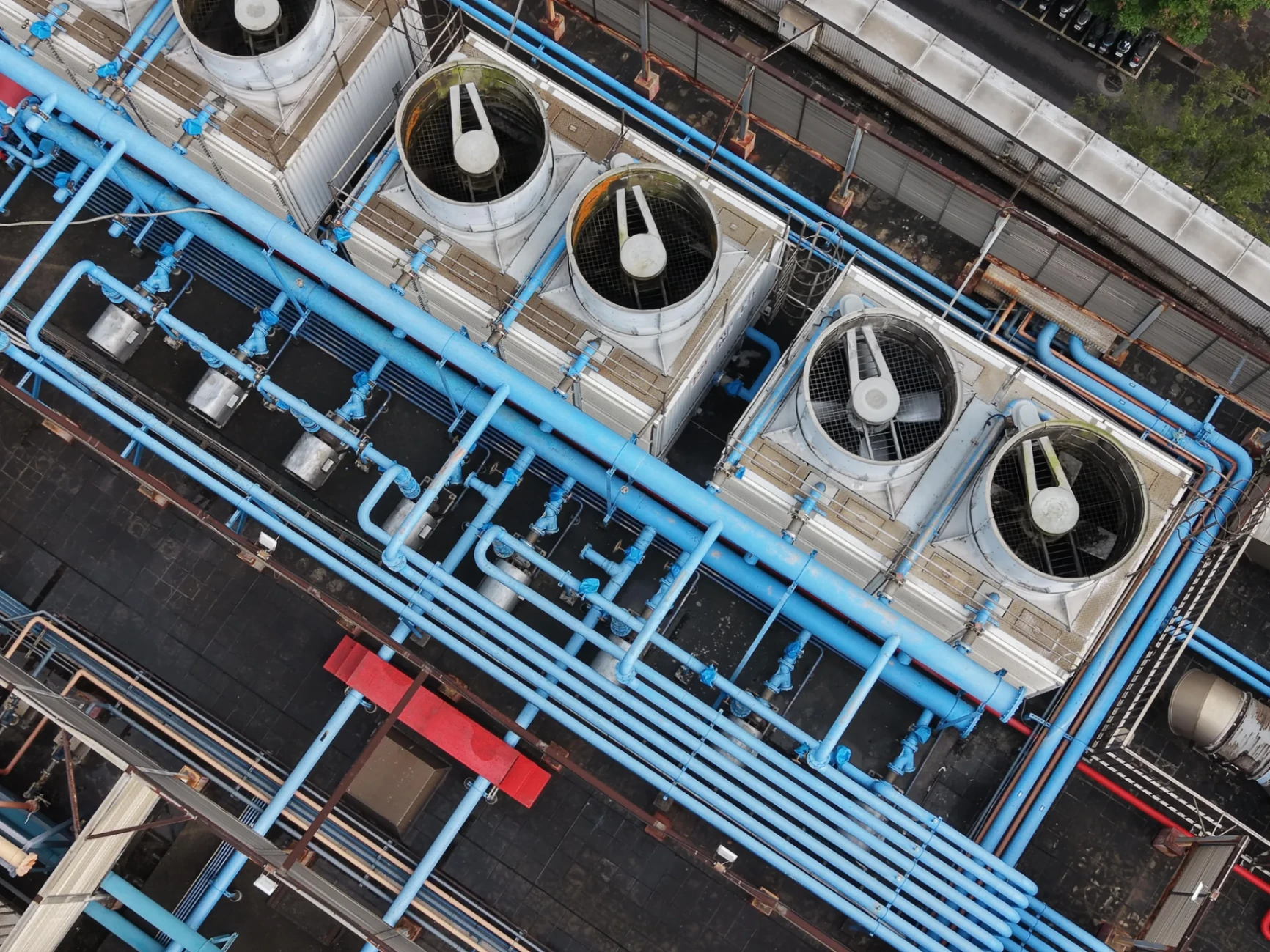
Pictured: Cooling-loop distribution piping
15+
Data center piping investigations
9
Root-cause categories screened
580+
Litigation-related projects
5
Cooling-loop polymer families (CPVC, EPDM, PE, PP-R, PVC)
The Stakes
The Stakes: Plastic Pipe Is Cheap. A Cooling Outage Is Not.
PVC and CPVC are chosen for corrosion resistance, light weight, and low installed cost. Corrosion resistance is not the same as chemical resistance. CPVC is not resistant to most hydrocarbon chemicals, and process fluids, inhibitors, and additives are a recurring source of contact the piping was never qualified against (see CPVC chemical resistance). Because environmental stress cracking in CPVC and PVC is now a recognised risk, some new data centers are specifying PE or PP-R instead, materials with different failure modes that need their own compatibility review. Over a multi-year program our experts were retained to investigate a series of polymeric piping and component failures across several mission-critical data-center campuses for a major data center operator. The failures spanned 2½ to 6 inch diameters, multiple polymers, and both pressurized cooling loops and gravity drain lines. The recurring theme: the plastic itself was rarely the villain. Most failures traced back to chemistry the system was never designed to see, joints that were not made correctly, or pressure transients the layout could not absorb.
Three things every plastics engineer watches for
Environmental Stress Cracking (ESC)
A stressed surface meeting an incompatible chemical turns normally ductile pipe brittle.
Notch sensitivity
A single scratch concentrates stress and seeds a crack.
Joint integrity
A cooling loop is only as sound as its joints.
Root Causes
Nine Root Causes Behind the Failures
A multitude of root causes have been found, with as many as nine at a single data center site, and they rarely act alone. Our inspection protocol is built to find where the risks actually are. Better still, when we join your design team early, we can help limit that risk before the ground is broken.
- 1
Environmental Stress Cracking (ESC) from chemical incompatibility
[PVC, CPVC]The single most damaging mechanism. A stressed pipe wall exposed to an incompatible chemical turns brittle and cracks, often years after install. Culprits are incompatible contaminants that migrate into the lines. Only trace levels, a few parts per million, are enough, and detecting them requires highly sensitive laboratory analysis.
- 2
Improperly made joints, installation defects, and joint embrittlement
[PVC, CPVC]Joints that are not made correctly are a leading source of leaks and premature failure, and incorrect technique can also leave the pipe wall vulnerable and seed environmental stress cracking. Whether a joint was properly made can be confirmed non-destructively.
- 3
Water hammer, slug flow, and pressure-surge fracture
[PVC]High-speed pressure transients such as water hammer and slug flow can fracture fittings that are sound at their rated static pressure.
- 4
Mechanical overload and dissimilar-stiffness loading
[PVC, CPVC]Excess lateral or torque loads, thermal expansion, and inadequate support can overload fittings, especially where plastic meets heavier metal components.
- 5
Over-torque at bolted connections
[PVC]Excessive assembly torque can crack saddles and flanges at their bolted connections.
- 6
Manufacturing and processing defects
[PVC, CPVC]Molding and extrusion defects, such as weak knit lines and molded-in stress, create latent weaknesses that surface under service loads.
- 7
Handling damage and notch sensitivity
[PVC]A scratch or gouge inflicted before installation can concentrate stress and grow into a through-crack.
- 8
Elastomer hardening and loss of seal
[EPDM]Valve seals can harden and lose positive shut-off, traced to compounding or manufacturing variation rather than service conditions.
- 9
Improper field repairs
[PVC]Surface-applied repair compounds can mask an unsound joint rather than actually fix it.
Engage us early
Bring us onto the design team, before the ground is broken
Most of these failures are cheaper to prevent than to prove. When we join an operator, developer, or design team early, we review materials, joints, and chemical compatibility while the system is still on paper, so the risks that cause flooded white space and unplanned downtime are engineered out before construction. We can also serve as your standing subject-matter experts for design review, and run the forensic investigation if a failure ever does occur.
Fractography
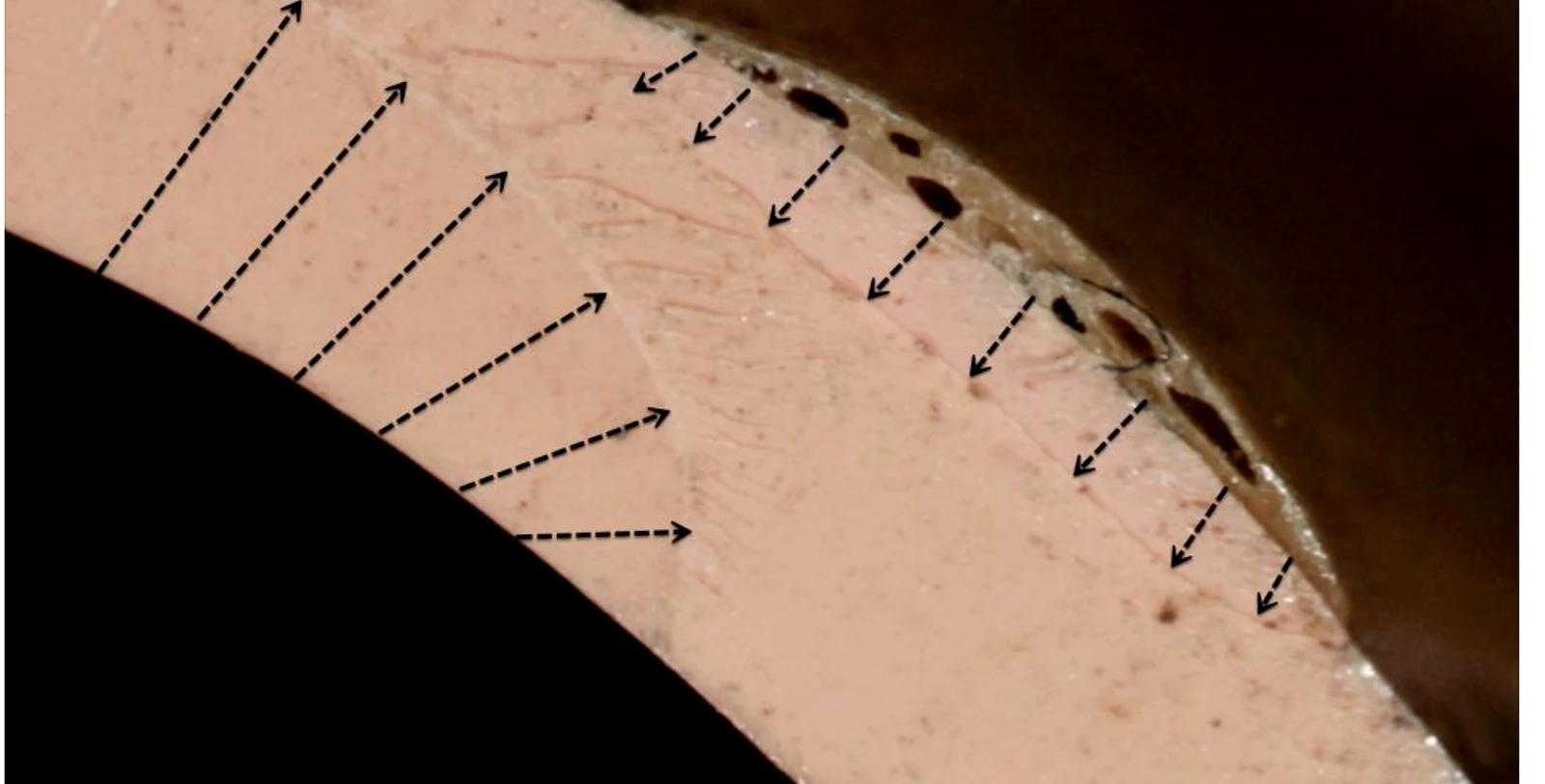
Reading the Fracture: Every Mechanism Leaves a Tell
Each failure mode writes its own signature into the fracture surface, and reading those signatures is central to how our experts determine root cause. Chemical stress cracking, high-speed fracture, an unbonded joint, and mechanical overload each leave a distinctive pattern that our microscopic and fractographic examination reveals.
Methodology
The Analytical Toolkit: How We Prove It
Root cause is an evidentiary conclusion, not an opinion. Our experts apply a layered battery through a network of independent, A2LA-accredited affiliate laboratories, many to recognized ASTM standards.
Visual & Microscopy
as-received documentation and fractography, stereomicroscopy, optical microscopy (beach marks, hackles, Wallner lines), SEM, proprietary non-destructive inspection techniques, sectioning and cross-section polishing.
Chemical
FTIR (skive/difference, solvent-extraction, surface-wash with library search), GC-MS of solvent extracts, Carbonyl Index (ASTM F2102), gravimetric contaminant quantification.
Thermal
DSC, Oxidative Induction Time (OIT, ASTM D3895).
Mechanical & Physical
tensile (ASTM D638 Type IV), chemical-compatibility and ESC under strain (ASTM D543), pipe flattening and ductility (ASTM F441 / F442), Shore durometer hardness, subject-versus-exemplar comparison.
Non-Destructive & Joint Evaluation
ultrasonic thickness and bond testing with grid mapping, statistical analysis of percent non-bonded interface, bevel/chamfer and insertion-depth inspection, joint compliance review (ASTM D2855 and ASTM F3328).
Engineering Analysis
Finite Element Analysis (FEA) of surge and slug-flow loading, service-condition and layout review.
Standards applied: ASTM D256, D543, D638, D1785, D2846, D2855, D3895, F441, F442, F493, F876/877, F2102, F3328.
See our full Testing Methods catalogTakeaways
Five Takeaways for Mission-Critical Plastic Piping
Chemistry is the silent killer.
Before specifying PVC or CPVC, verify compatibility with every chemical the system can ever contact. Incompatible contaminants can attack CPVC at only a few parts per million, and detecting them takes highly sensitive laboratory analysis.
The joint is the system.
A high fraction of failures traced back to joints that were not made correctly. Correct joint technique is essential, and joint integrity can be verified non-destructively.
Design for the transient, not just the static pressure.
Water hammer and slug flow fractured fittings that were fine at rated pressure. Surge control, supports, and adequate pipe legs at direction changes matter.
Handle plastic like it is notch-sensitive, because it is.
A scratch from rough handling or storage can become tomorrow's through-crack. Inspect fittings before they go in the wall.
Do not patch a bond failure.
Surface repair compounds hide an unbonded joint, they do not fix it. Failed joints need replacement to a verified standard.
FAQ
Data Center Piping Failure Questions
Related Coverage
Explore Related Investigations & Services
Pipe Failure Analysis
Forensic root-cause analysis of CPVC, PEX, and PVC piping systems for litigation and subrogation.
Read moreCPVC Fire Sprinkler
Environmental stress cracking, incompatible caulk and foam, and condo and commercial case files.
Read morePEX Failures
Chlorine oxidation, expansion-fitting cracking, and antioxidant depletion behind PEX water-loss claims in warm regions.
Read moreLoss of Water & Subrogation
Forensic support for carriers, adjusters, and subrogation counsel behind water-damage claims.
Read moreForensic Testing & Analysis
Court-admissible testing through independent, A2LA-accredited affiliate laboratories.
Read moreTesting Methods
The full catalog of standardized test methods our experts run, including the ASTM battery used here.
Read moreAccreditations & Affiliations
Independent accredited labs across North America, Europe, Asia-Pacific, Australia, and the Middle East

For Facility & Operator Teams
Active or Recent Piping Failure?
On-site assessment, sample preservation guidance, and root-cause analysis to prevent the next outage across your fleet.
Engage our forensic teamFor Attorneys
Building a Warranty or Litigation Matter?
Defensible, ASTM-standard testing through independent, A2LA-accredited affiliate laboratories, with expert reports built to survive Daubert scrutiny.
Request an Expert ReviewFor Insurers & Subrogation
Pursuing Recovery on a Loss?
Chemical-to-source attribution, joint-defect quantification, and surge-event reconstruction tied to the responsible party.
Discuss a subrogation fileTell Us About Your Data Center Piping Failure
Share the facility, the system, the pipe material, and what you have. We will respond within one business day with next steps and whether on-site sampling, a non-destructive bond survey, or laboratory analysis makes sense first.
Fast Initial Review
No-cost initial assessment for attorneys, insurers, manufacturers, and property owners.
Daubert-Aligned Methodology
ASTM-standard testing through independent, A2LA-accredited affiliate laboratories, built to survive a Daubert challenge.
Prefer to Call?
+1 (989) 281-4465