
PEX Domestic Water Forensics
PEX Pipe Failure Analysis
When a PEX domestic water system turns brittle and cracks years before its expected 50-year service life, the manufacturer almost always blames the installer, the water chemistry, or the pressure/water temperature. PEX pipe failure analysis determines what actually happened. PEX failures occur primarily by one mechanism, oxidative degradation. Once the antioxidant stabilizers that protect the pipe against oxidation are depleted, the pipe will rapidly degrade and fail. Our forensic work establishes whether the depletion of the antioxidant stabilizers was caused by a defective pipe, a flawed installation, or an aggressive service environment. Much of this work is tied to active litigation, so we keep case-specific detail off this page. Contact us directly to discuss your matter in confidence. Our team has investigated plastic pipe failures from buildings across the country and supported plaintiff counsel in product-liability and class-action matters, using SEM, ASTM D3895 oxidative induction time testing, and analysis through a network of independent, A2LA-accredited affiliate laboratories to build court-ready opinions.
Retained by both plaintiff and defense, for technical objectivity, not advocacy.
Forensic Evidence
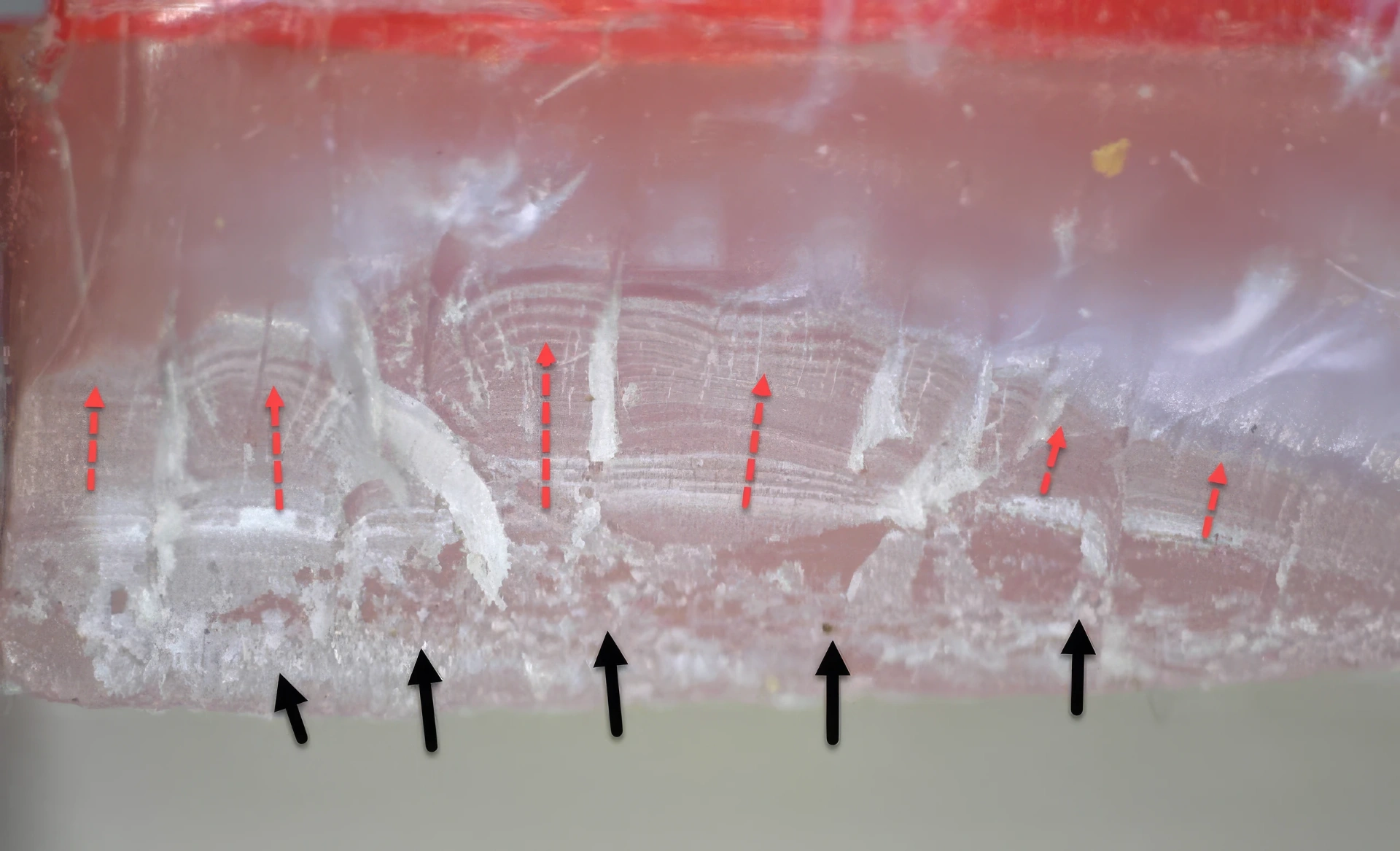
Pictured: PEX inside-wall oxidative degradation
580+
Litigation-Related Projects
20+ Yrs
Pipe Forensics
A2LA
Accredited Affiliate Labs
50-Year
PEX Design-Life Benchmark
Case Snapshots
Recognize Your Case in 30 Seconds
Three fact patterns we see most often on PEX pipe failure matters.
Snapshot A: Product Liability / Manufacturing Defect
- Setting
- Single-family and multi-unit residential, commercial plumbing
- Pipe
- PEX hot-water distribution
- Failure
- Oxidative embrittlement and cracking in the pipe body from premature antioxidant depletion
- Our Role
- Plaintiff expert witness, forensic analyst, class-action and MDL support
- Services
- SEM, OIT by DSC (ASTM D3895), FTIR, GC-MS, expert report and testimony
- Outcome
- Premature failure tied to an improperly-stabilized pipe, supporting product-liability and class recovery
Snapshot B: Construction Defect / Installation
- Setting
- Residential and commercial plumbing using expansion-fitting systems
- Pipe
- PEXa with expansion fittings, or pipe routed through sharp bends
- Failure
- Oxidative cracking accelerated by residual stress at expanded fitting ends or over-tight bends
- Our Role
- Plaintiff expert witness, forensic analyst
- Services
- Failure-location mapping (joint vs bend vs pipe body), bend-radius measurement, SEM, OIT, report
- Outcome
- Stress-accelerated failure attributed to installation, or ruled out where the failure is in unstressed pipe
Snapshot C: Chlorine Oxidation / Service Environment
- Setting
- Warm, high-chlorine markets (California, Florida, Texas, Hawaii) and recirculated on-demand hot-water systems
- Pipe
- PEX hot-water lines
- Failure
- Oxidative degradation of the inner wall driven by hot, chlorinated, often chlorine-dioxide-treated water
- Our Role
- Plaintiff expert witness, forensic analyst
- Services
- Inside-wall SEM, OIT, water-chemistry assessment, service-life evaluation against ASTM F2023 assumptions
- Outcome
- Failure characterized as premature versus normal end-of-life
Signature Framework
How PEX Fails: One Mechanism, Three Theories
PEX fails by a single mechanism: oxidative degradation. As long as antioxidant stabilizers are present in the pipe wall, PEX will not oxidize. Failure begins wherever the antioxidants are depleted. The forensic and legal question is never whether the pipe oxidized, it is why the antioxidants were depleted, because the answer points to the responsible party.
| Theory | Cause | Mechanism | Typically Liable |
|---|---|---|---|
| Manufacturing defect | Antioxidant stabilizers inadequate to protect the pipe through decades of hot chlorinated service | The pipe oxidizes and cracks after only a few years in service, or cracks develop on the outside of the pipe at expansion joints | PEX pipe manufacturer |
| Installation defect | Expansion-fitting stress at the pipe end, or bends tighter than the allowed radius without bend supports | Residual stress accelerates oxidative embrittlement at the stressed location | Installing contractor |
| Service environment | Hot, recirculated, high-chlorine water, especially chlorine-dioxide-disinfected or high-mineral-content water | Hot flowing water extracts antioxidants from the inner wall and chlorine oxidizes the exposed material | Case-dependent (water utility, system design, or none if the pipe simply reached end of life) |
Manufacturing defect
- Cause
- Antioxidant stabilizers inadequate to protect the pipe through decades of hot chlorinated service
- Mechanism
- The pipe oxidizes and cracks after only a few years in service, or cracks develop on the outside of the pipe at expansion joints
- Typically Liable
- PEX pipe manufacturer
Installation defect
- Cause
- Expansion-fitting stress at the pipe end, or bends tighter than the allowed radius without bend supports
- Mechanism
- Residual stress accelerates oxidative embrittlement at the stressed location
- Typically Liable
- Installing contractor
Service environment
- Cause
- Hot, recirculated, high-chlorine water, especially chlorine-dioxide-disinfected or high-mineral-content water
- Mechanism
- Hot flowing water extracts antioxidants from the inner wall and chlorine oxidizes the exposed material
- Typically Liable
- Case-dependent (water utility, system design, or none if the pipe simply reached end of life)
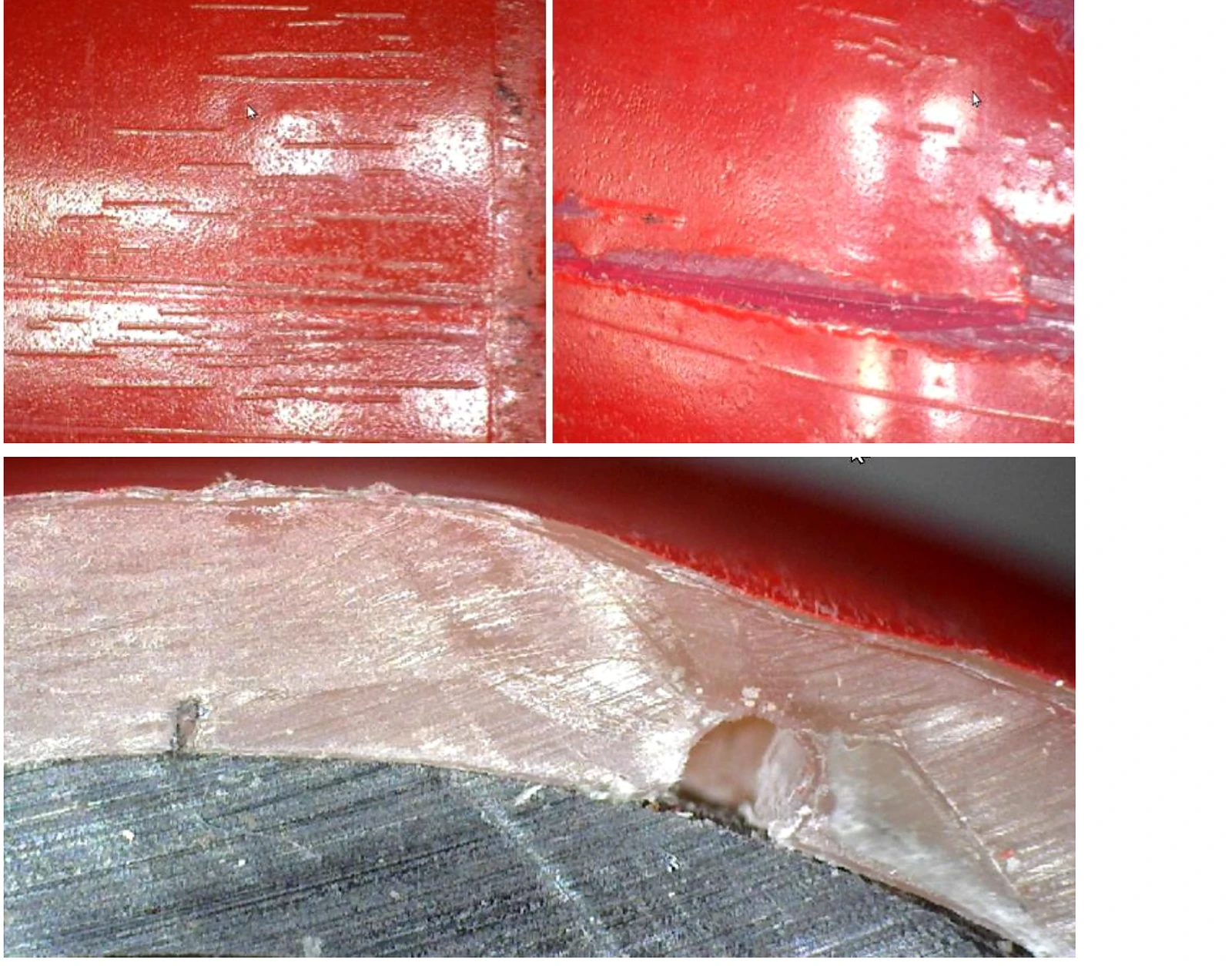
The tell: SEM of the fracture surface shows where a crack started, the inside surface, the outside surface, or within the pipe wall. Each origin points to a different failure mode, which separates competing theories about what drove the failure.
The Challenge
Manufacturer vs Installer, on Fragile Evidence
PEX failure cases are won or lost on the manufacturer-versus-installer question. When a PEX system fails, the manufacturer routinely argues that the installer bent the pipe too sharply or that the water was unusually aggressive, while the plaintiff argues the pipe was defective from the factory. Resolving that dispute requires unarguable proof. In the rush to restore water service, the failed pipe is often cut out, sent to the pipe manufacturer, damaged, or discarded. Once the failed pipe sample is gone, proving causation to a scientific certainty becomes very difficult. There is also a timing trap. Passing ASTM F876 and F877 at the time of manufacture does not prove the pipe will survive decades of hot chlorinated service, and that in-service performance is what our forensic analysis evaluates. Finally, many states have a statute of repose around ten years, and some PEX failures surface only as that window is closing, so early forensic involvement matters.
Approach & Methodology
How We Build a PEX Pipe Failure Case
- 1
Intake and triage
Before any pipe is shipped, we ask the questions that shape the hypothesis: who manufactured the pipe, how long it was in service, whether failures cluster at joints, bends, or the pipe body, whether the lines are hot, cold, or recirculated, the pipe color, and whether failures are increasing over time. Failures away from any joint or bend cannot be an installation defect.
- 2
SEM of the fracture surface
Scanning electron microscopy shows where the crack initiated (the inside surface, the outside surface, or within the pipe wall) and reveals the patches of microcracking that mark oxidatively degraded regions next to sound, un-cracked material.
- 3
Oxidative induction time by DSC (ASTM D3895)
OIT measures how much antioxidant protection remains in the pipe wall. Our experts interpret the result against the pipe's expected service life to distinguish adequately stabilized pipe from pipe that has oxidized prematurely.
- 4
FTIR and DSC
FTIR confirms the polymer, and DSC is used when FTIR is not conclusive. Together they characterize oxidation products and rule out contributing chemistry.
- 5
Accelerated oxidation screen
A length of pipe is oven aged under accelerated aging conditions to determine if it was properly stabilized.
- 6
Failure-location and bend-radius mapping
Because stress accelerates oxidation, we document whether failures sit at expansion fittings or bends and measure bend radius (PEX usually holds a bend, so an over-tight radius is measurable even after removal), tying the failure to installation or ruling installation out.
- 7
Standards as anchors
We evaluate the pipe against ASTM F876 and F877 (which set a 50-year design basis) and put ASTM F2023 accelerated chlorine-resistance results in context, since that test uses sodium hypochlorite in purified water and does not represent chlorine-dioxide or high-mineral service.
Key Findings
What Our Reports Establish
Defective pipe due to insufficient stabilization against oxidation
SEM microcrack patterns together with OIT and related thermal analysis indicate whether the pipe carried adequate oxidation protection for its expected service life. PEX is required to carry enough antioxidant to last 50 years, so brittle cracking after only a few years points to insufficient stabilization.
Inside-initiated cracks rule out installation
A crack that starts on the inner wall, away from any joint or bend, cannot have been caused by how the pipe was installed.
Stress location separates installation from manufacture
Failures concentrated at expansion fittings or over-tight bends point to installation stress; failures distributed through unstressed pipe body point to the pipe itself.
Process matters: PEXa and PEXc vs PEXb
PEXa and PEXc deplete antioxidants during crosslinking while PEXb does not, so the manufacturing process is itself relevant to oxidation resistance and foreseeability.
Differentiator
PEX vs CPVC, and Why the Legal Theory Differs
Attorneys and property managers often ask which material is better. As forensic scientists who have investigated both fail, our answer is that it depends on the application, and the two materials fail for opposite reasons, which means the legal theory is fundamentally different.
| Attribute | PEX | CPVC |
|---|---|---|
| Primary failure mode | Oxidative degradation (chlorine) | Environmental stress cracking (ESC) |
| Resistant to | Building chemicals, spray foam, caulk, freezing | Aqueous solutions of corrosive acids, aqueous bleach, and oxidation by chlorinated water |
| Vulnerable to | Hot recirculated chlorinated water, especially chlorine dioxide; installation stress | Contact with most hydrocarbon chemicals (spray foam, caulks, moldicides); freezing |
| Best suited for | Most cold and intermittent hot-water plumbing (PEXb most oxidation-resistant) | Continuously recirculated on-demand hot water |
| Core legal question | Was the oxidation caused by defective manufacture, installation stress, or service? | What was the source of the incompatible chemical that caused the ESC? |
PEX
- Primary failure mode
- Oxidative degradation (chlorine)
- Resistant to
- Building chemicals, spray foam, caulk, freezing
- Vulnerable to
- Hot recirculated chlorinated water, especially chlorine dioxide; installation stress
- Best suited for
- Most cold and intermittent hot-water plumbing (PEXb most oxidation-resistant)
- Core legal question
- Was the oxidation caused by defective manufacture, installation stress, or service?
CPVC
- Primary failure mode
- Environmental stress cracking (ESC)
- Resistant to
- Aqueous solutions of corrosive acids, aqueous bleach, and oxidation by chlorinated water
- Vulnerable to
- Contact with most hydrocarbon chemicals (spray foam, caulks, moldicides); freezing
- Best suited for
- Continuously recirculated on-demand hot water
- Core legal question
- What was the source of the incompatible chemical that caused the ESC?
Outcome & Impact
Class-Action and Individual Matters
Across the PEX failures our team investigates, the large majority trace to a major PEX manufacturer whose pipe oxidizes prematurely in hot chlorinated service. The forensic basis is consistent and repeatable: SEM shows microcrack patterns and OIT indicates whether the pipe carried adequate oxidation protection for its service life, evidence that is difficult to rebut. In class-action and MDL matters the central challenge is proving the failures are systemic rather than one-offs, and a defensible, repeatable forensic protocol applied across many samples is what establishes that the failures are common and will continue.
Why This Matters
The 2000s PEX Boom Is Now Deep Into Its Service Life
PEX went into an enormous number of homes and buildings during the 2000s construction boom, and that pipe is now well into its service life. Heat accelerates PEX degradation rate. Therefore, PEX failures are generally most prevalent in recirculated hot water piping systems and also in warmer Southern climates due to higher ambient temperature and generally higher levels of chlorine in the water. In practice that means recirculated on-demand hot-water lines that expose the pipe to constant turbulent hot water, and warm, high-chlorine markets such as California, Florida, Texas, and Hawaii, where chlorine dioxide and high mineral content make real-world conditions far more aggressive than the accelerated test assumptions behind published service-life claims. For owners and counsel, the practical point is to preserve evidence and obtain a forensic opinion early, both to prove causation and to stay ahead of statute-of-repose deadlines.
Quick-Reference Checklists
Preserve the Evidence
Plaintiff / Product-Liability Attorney
First 72 Hours
- Retain an experienced plastic-pipe forensic expert immediately, ideally before the failed section is removed.
- Video the active leak and photograph the surrounding installation.
- Supervise removal so the failed pipe and its fittings are preserved intact.
- Wrap the sample in pure aluminum foil, bag, tag with date and location, and maintain a written chain of custody.
- Record the pipe manufacturer, color, whether the line is hot, cold, or recirculated, and whether the failure is at a joint, a bend, or the pipe body.
- Do not return the only sample to the manufacturer.
- In discovery, request the manufacturer quality-control records for the specific lot, the ASTM F876/F877 compliance data, and any internal testing on antioxidant content and long-term oxidative performance.
Property Owner / HOA / Property Manager
Building Response
- Route the engagement through your attorney first to preserve privilege.
- Preserve every failed sample rather than discarding it during repairs.
- If failures are recurring, commission a forensic assessment to determine whether the problem is systemic before more of the system fails.
Brands and PEX Types We Investigate
All Major PEX Brands
We investigate failures across all three PEX types, PEXa, PEXb, and PEXc, and across the major domestic-water brands. NIBCO, Uponor, and Zurn have each been named in PEX system class-action litigation: Cole v. NIBCO, Inc., No. 13-cv-7871 (D.N.J.), which covered PEX tubing, fittings, and clamps and received final approval in 2019; George v. Uponor, Inc. (D. Minn.), concerning high-zinc yellow brass fittings; and In re Zurn Pex Plumbing Products Liability Litigation, MDL No. 1958 (D. Minn.), concerning F1807 yellow brass fittings. In the Uponor and Zurn matters the alleged defect was dezincification of the brass fittings rather than the PEX tubing itself, a distinction that matters whenever a failure is being attributed to the wrong component. The manufacturer is typically printed along the length of the pipe, and the PEX type matters technically: PEXa and PEXc deplete antioxidants during crosslinking, while the PEXb process does not, which makes PEXb inherently more resistant to oxidation.
Retained by both plaintiff and defense, for technical objectivity, not advocacy.
PEX Brands
NIBCO
Uponor
Zurn
Plastic Expert Group is an independent forensic consultancy retained by plaintiff and defense alike; these brands are listed as a matter of public record, not as advocacy against any manufacturer. Cole v. NIBCO, Inc., George v. Uponor, Inc., In re Zurn Pex Plumbing Products Liability Litigation.
PEX Types
PEXa
Crosslinking depletes antioxidant stabilizers.
PEXb
Crosslinking process does not deplete antioxidants; inherently more oxidation-resistant.
PEXc
Crosslinking depletes antioxidant stabilizers.
FAQ
Common Questions About PEX Pipe Failures
Related Use Cases
Related Use Cases
Pipe Failure Analysis
Our broader pipe-failure practice: CPVC and PEX investigations across litigation, subrogation, and HOA matters.
Read moreCPVC Fire Sprinkler Failures
Environmental stress cracking from spray foam, fire caulk, antifreeze, and installation defects in life-safety systems.
Read moreCPVC Environmental Stress Cracking
The failure science: how ESC happens, how we prove it, and how to prevent it.
Read morePlastic Failure Analysis
All polymer failure modes beyond piping: products, parts, joints, coatings, and roofing membranes.
Read moreWater-Loss & Subrogation
Forensic root-cause support for carriers, adjusters, and subrogation counsel behind PEX water-loss claims.
Read moreData Center Piping
CPVC and PVC drain, chilled-water, and condensate line failures behind mission-critical data-center water-loss events.
Read moreRelated Services
Accreditations & Affiliations
Independent accredited labs across North America, Europe, Asia-Pacific, Australia, and the Middle East

Plaintiff / Product-Liability Attorney
Handling a PEX Pipe Failure or Class-Action Matter?
We separate manufacturing defect from installation and service-environment causes with SEM, OIT, and A2LA-accredited testing, and we support plaintiff counsel through deposition and trial.
Property Owner / HOA / Property Manager
Seeing Repeated PEX Failures in Your Building?
A forensic assessment determines whether the problem is a defective pipe, an installation issue, or your water, and whether it is systemic.
Tell Us About Your PEX Pipe Failure
Share the building, what failed, and what you have. We will respond within one business day with next steps and whether a sample review or non-destructive assessment makes sense first.
Fast Initial Review
No-cost initial assessment for attorneys, insurers, manufacturers, and property owners.
A2LA-Accredited Methodology
Court-ready testing built to survive a Daubert challenge.
Prefer to Call?
+1 (989) 281-4465