
Product Design
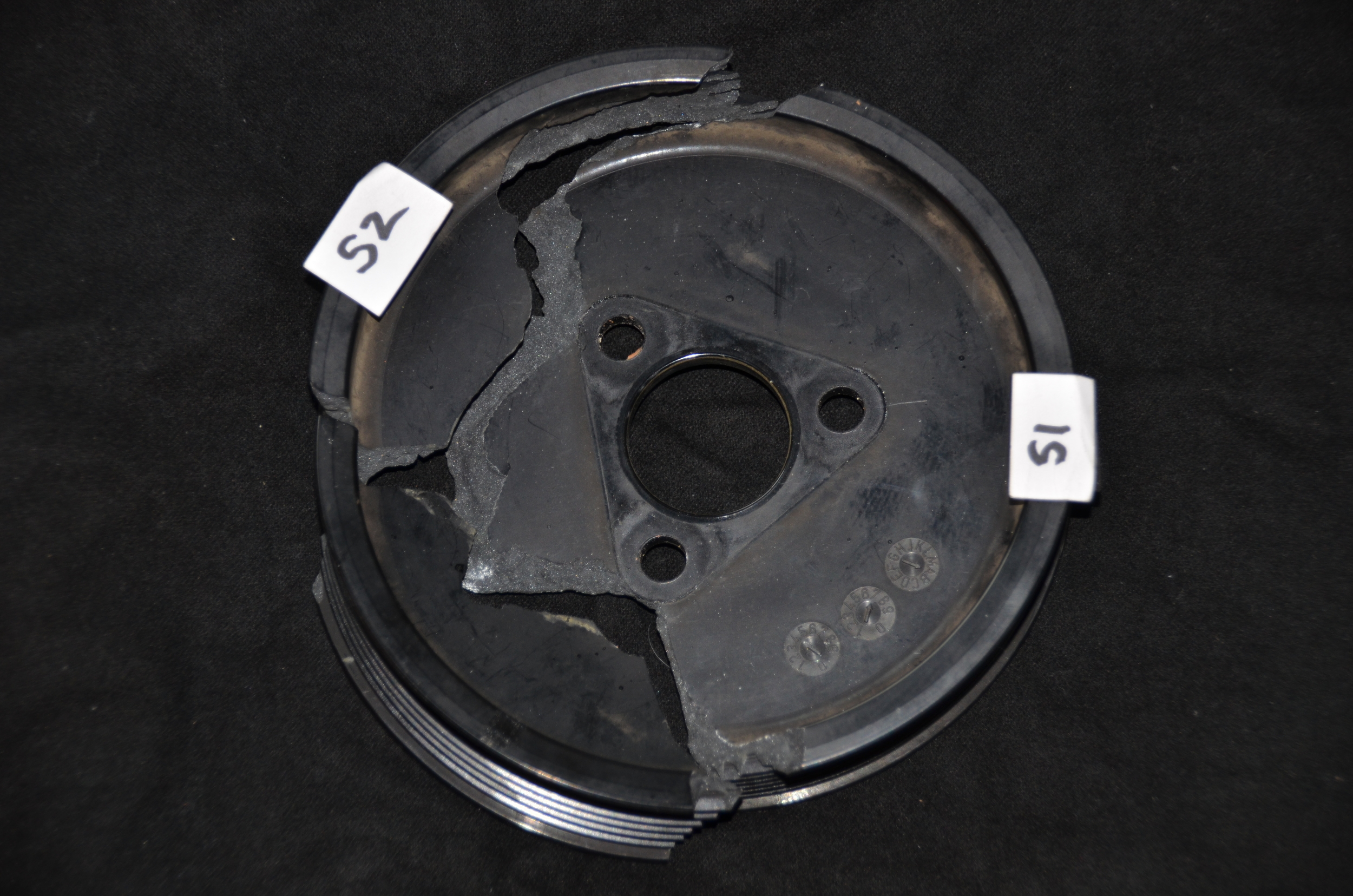
Failure of Automotive Pulley Caused by Defective Part Design
By Dr. Duane Priddy Sr. · Published June 7, 2016
FORENSIC EVIDENCE
Pictured: The fractured black composite automotive pulley photographed on dark evidence cloth with paper exhibit labels S1 and S2, showing a large wedge-shaped section broken out of the pulley face
In an effort to reduce automobile weight and increase fuel economy, automobile manufacturers are replacing metal parts with lighter-weight materials. However, critical automotive components that could lead to serious injury if a failure occurs, should always be made using metal. For example, some automotive companies have replaced metal pulleys in the engine compartment with synthetic composite materials. If a failure of a pulley occurs in the engine, the engine stops. When the engine suddenly stops while traveling at high speeds, a serious injury or death may occur. A case in point, a car was traveling at a high rate of speed on a California freeway. The glass fiber reinforced composite pulley suddenly broke causing the engine to suddenly stop. Power steering was lost. Because the car’s battery was weak, the lights dimmed. The result was a rear-end collision that left the passenger dead. Our analysis of the failed pulley revealed significant design and manufacturing defects in the pulley.
Related articles



Discuss your matter with a polymer scientist
Our experts provide independent technical opinion on plastic and polymer failures.